

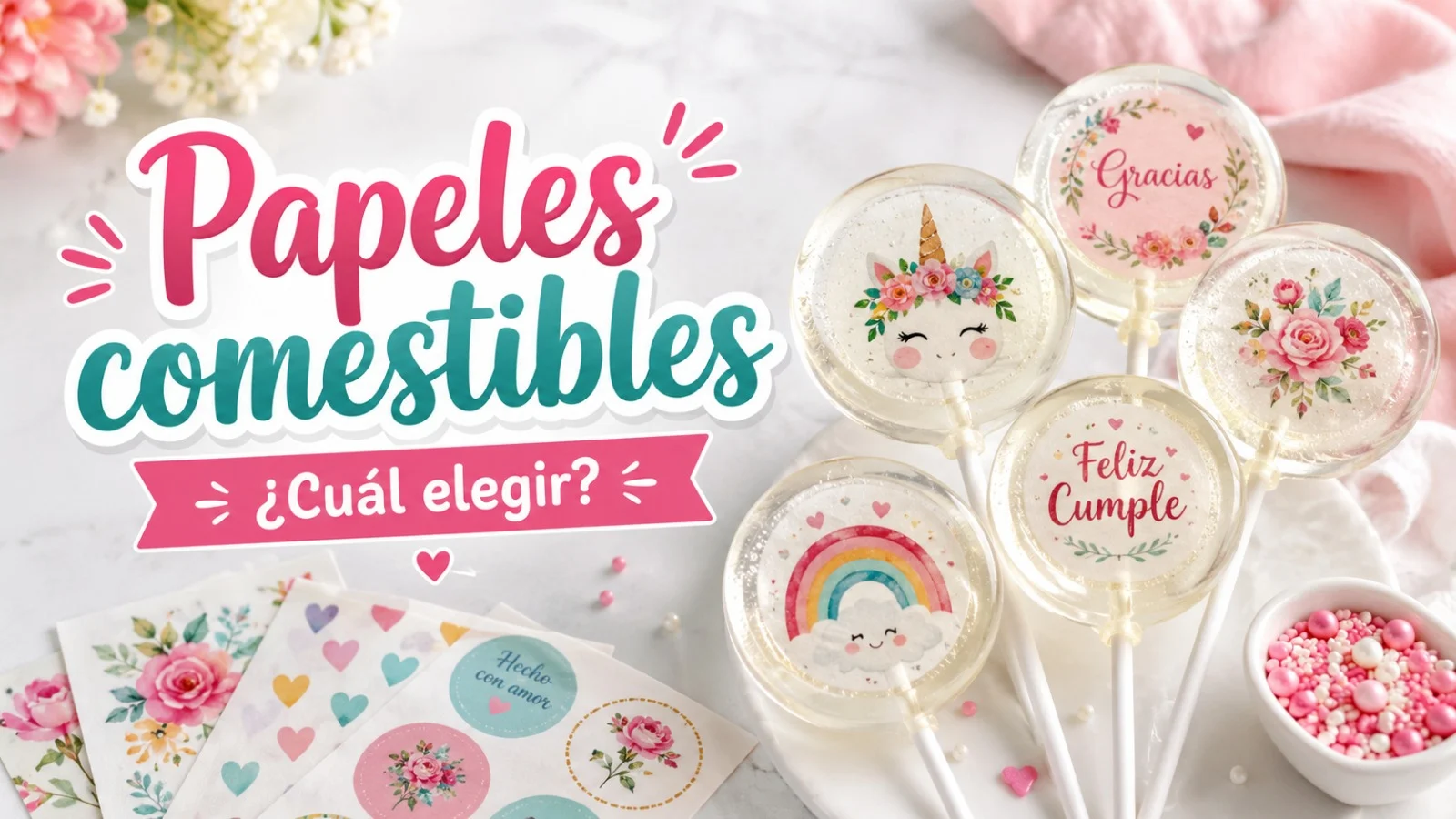
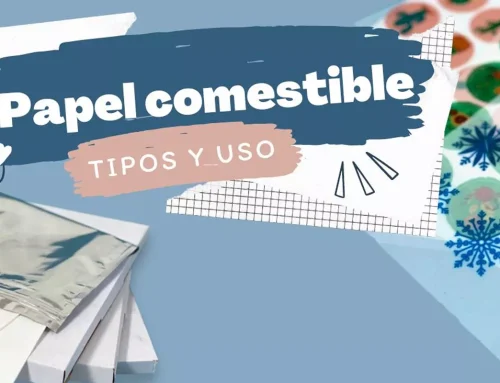
If you’ve ever looked for edible sheets to print an image, decorate a cake, or personalize a lollipop, you’ve probably come across these three names: rice paper, wafer paper, and sugar paper.
And it’s easy to think: “Well, if all three are edible and printable… they’ll give more or less the same result, right?”
Well no.
The three have very different characteristics and, when we are also going to work with isomalt at high temperature, choosing well ceases to be an aesthetic issue and becomes something much more important.
Because one thing is placing an image on top of a cake, and quite another is putting that image inside an isomalt lollipop.
Today we’re going to look at the differences between rice paper, wafer paper, and sugar paper, what they’re made of, how they behave, and which one to choose when making personalized lollipops.
Before we begin: be careful with the names
Here we have our first little problem.
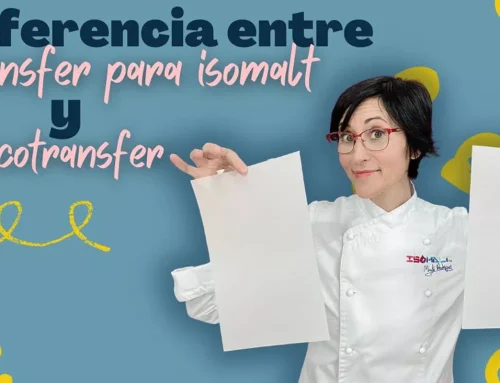
In the edible printing market, the terms ” rice paper ” and ” wafer paper ” are sometimes used interchangeably. In fact, some manufacturers market wafer paper made primarily from potato starch under the name ” rice paper.”
However, we also find authentic sheets made from rice flour or starch, which are usually much thinner and more delicate. Therefore, rather than relying solely on the brand name, it’s important to always check:
- its composition;
- its thickness;
- its flexibility;
- ease of cutting;
- And, above all, what we want to use it for.
And this last point is fundamental.
1. Rice paper: thin, delicate, and not suitable for everything
Authentic edible rice paper is made primarily from rice or rice starch and water, although the composition may vary depending on the manufacturer and may be combined with other starches.
It is usually a material:
- fine;
- light;
- slightly translucent;
- quite delicate;
- with a virtually neutral taste.
It can work very well for certain pastry decorations where we are looking for a thin and discreet sheet.
But when we talk about isomalt lollipops, the story changes.
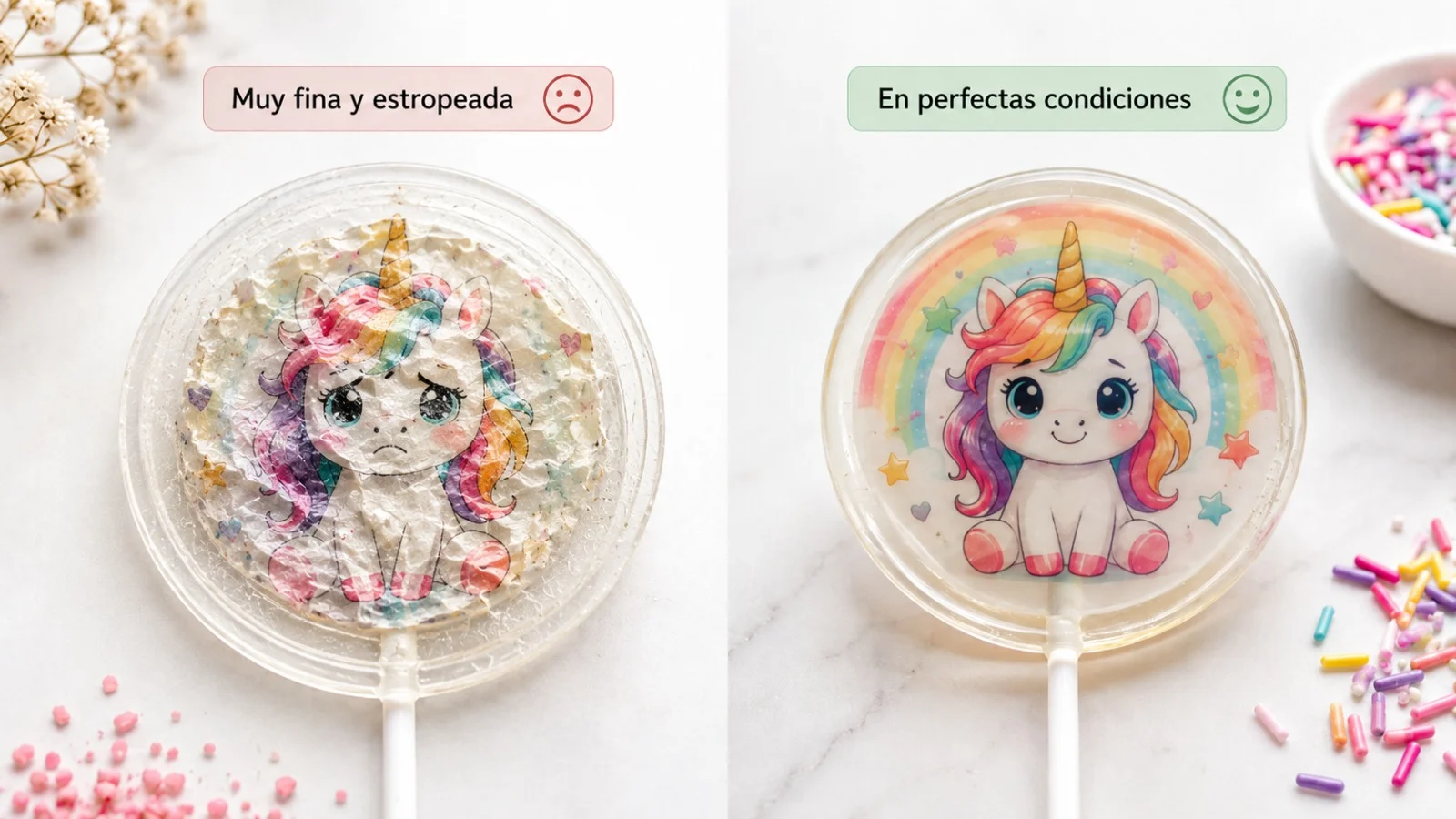
Why don’t we use rice paper for lollipops?
Mainly due to its thinness and fragility in the face of the process we need to carry out.
Isomalt is worked at very high temperatures. Depending on the product and the technique, it must reach 180 °C for firing, although for decoration we work with lower temperatures, but still excessively high.
Therefore, we are not simply placing a print on top of an already cold preparation.
We are introducing an edible leaf into contact with very hot isomalt.
And that’s where a paper that’s too thin can become deformed, curled, damp, or lose stability.
Based on our experience working with lollipops, thin rice paper does not have the structure we need to withstand this process well, so it is not our choice for incorporating designs within the isomalt.
It can be great for other techniques.
Not for our lollipops.
2. Wafer paper: our favorite for isomalt lollipops
Here we come to the protagonist.
Wafer paper is an edible paper usually made with potato starch, water and a small amount of vegetable oil.
It is light, slightly translucent, and virtually tasteless.
But it has a particularly interesting feature: we can find it in different thicknesses.
And this, when we make personalized lollipops, makes a huge difference.
Paper weights and thicknesses vary depending on the manufacturer. It’s common to find sheets approximately 0.3 mm, 0.4 mm, and 0.6 mm thick, as well as even thicker versions.
We are going to focus on the two that interest us most:
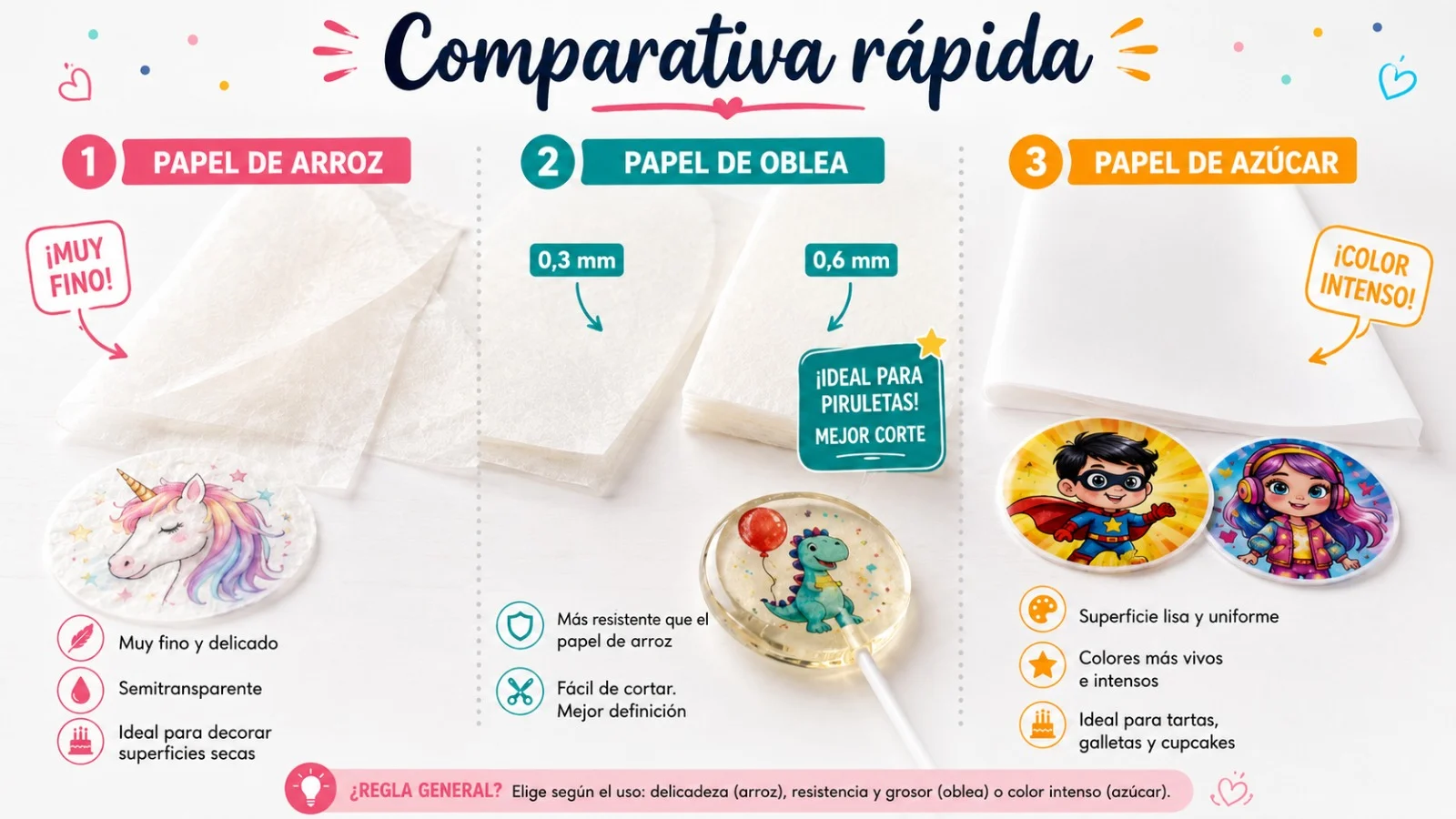
0.3 mm wafer paper
It is a thinner and more flexible wafer.
It is suitable for:
- some cake decorations;
- edible flowers;
- lightweight elements;
- Prints that don’t need too much structure.
Precisely because it is thinner it has greater flexibility, but also less body and resistance.
And when we’re going to put an impression into an isomalt lollipop, that extra thickness we’re missing can make itself noticeable.
0.6 mm wafer paper
Here we found our favorite option.
Wafer paper 0.6 mm thick is considerably more consistent and structured. Manufacturers specifically recommend thicknesses around 0.6 mm for projects requiring greater rigidity, such as cake toppers and three-dimensional elements.
And that resistance is precisely what interests us when we work with isomalt.
Why do we use 0.6 mm wafer for our lollipops?
Because it offers us several advantages:
It has more body. The print lasts much better throughout the entire process.
It’s more stable. When you handle it and place it inside the lollipop, it holds its shape better.
It allows us to work with more complex designs. And here we arrive at one of the points that is fundamental for us: the cut.
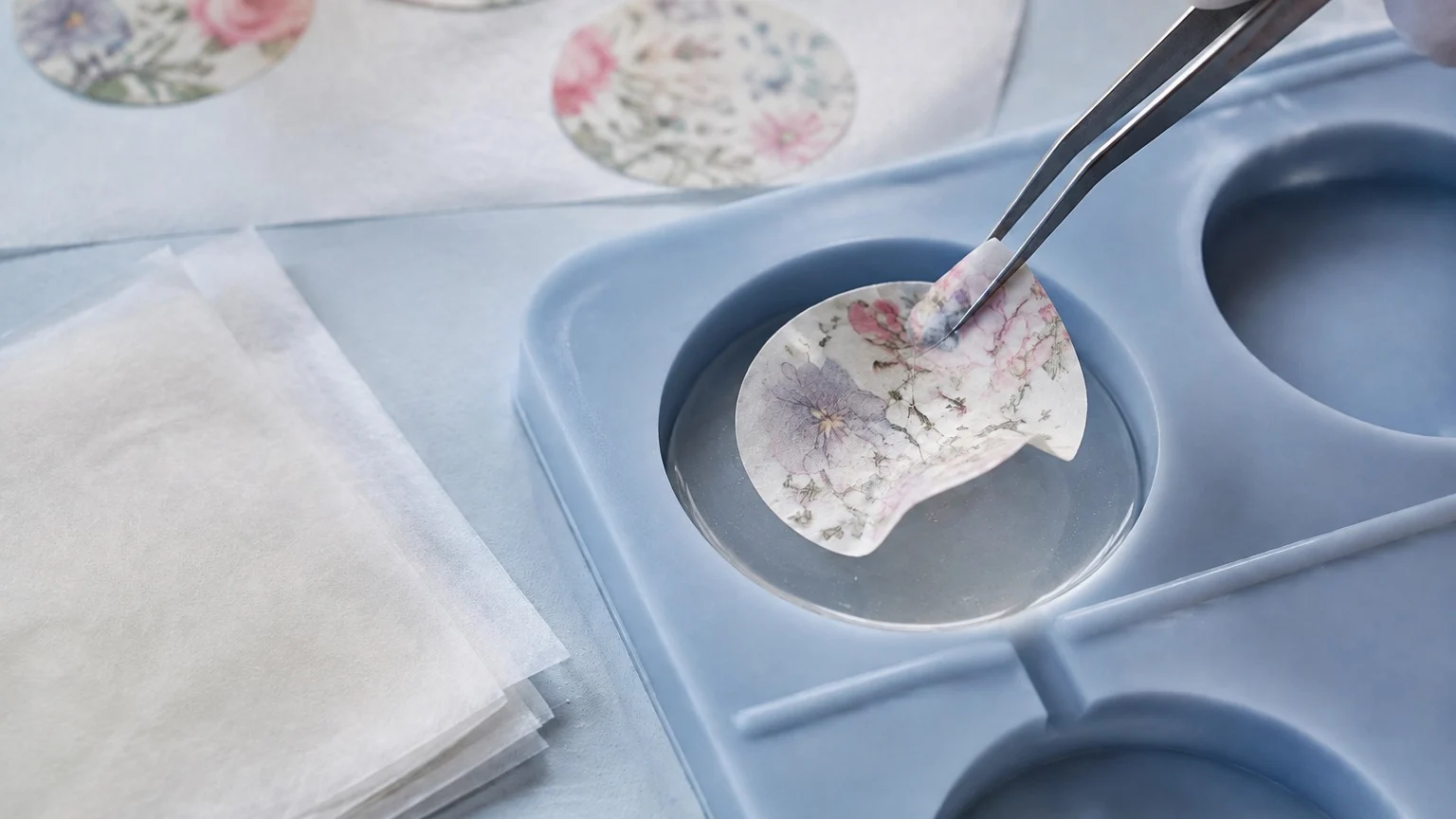
The cut: one of the great advantages of the 0.6 mm wafer
When you see a finished personalized lollipop, it may seem like we’ve simply printed an image, cut it into a circle, and placed it inside.
But often that’s not the case.
We work with characters, animals, flowers, logos, letters and designs with irregular silhouettes and lots of small indentations and protrusions.
And the more complex the drawing, the more important it becomes to use paper that can be cut correctly.
The 0.6 mm wafer paper makes our work much easier here.
Its greater rigidity allows us to make cleaner cuts and control the shapes much better.
For example, imagine we have to cut:
- a character’s hair;
- the ears of an animal;
- a crown;
- a flower;
- several leaves;
- a logo with an irregular silhouette.
In all these cases, the precision of the cut is part of the final finish of the lollipop.
That’s why thickness isn’t simply a matter of strength.
It is also a matter of accuracy and quality of the result.
And in designs with many shapes, for us the 0.6 mm wafer is essential.
3. Sugar paper: when you want a spectacular print
Sugar paper is quite different.
It is also known as sugar sheet, icing sheet or frosting sheet and is usually made up of a combination of sugar, modified starches, maltodextrin, glycerin, water, dextrose, stabilizers and other food ingredients, the specific formulation of which depends on each manufacturer.
It usually comes attached to a protective film that we have to remove before using it.
Its biggest advantage?
Print quality.
It has a much smoother and whiter surface than a wafer, which allows for the following:
- more intense colors;
- sharper photographs;
- deeper blacks;
- sharper small details;
- visually striking impressions.
In fact, sugar sheets usually provide a more intense color reproduction than wafers, precisely because of their smooth, white surface.
Placing a photograph on a cake, a cookie, or a similar creation can be fantastic.
But for our lollipops, another problem arises.
Sugar paper is considerably more awkward to cut.
When we need simple forms, it’s not a big problem.
But when we get into complex designs, things change.
Its texture is more flexible and somewhat softer than the thick wafer, so very small cutouts and silhouettes with many details are much more difficult for us to make accurately.
And if there’s one thing we’ve learned after cutting out thousands and thousands of images, it’s that when you have a character full of details, you want the paper to cooperate with you… not fight with it.
That’s why, even though sugar paper makes a fantastic impression, it’s not our first choice for the interior designs of our lollipops.
Rice paper, wafer and sugar: a quick comparison
| Feature | Rice paper | Wafer paper 0.3 mm | Wafer paper 0.6 mm | Sugar paper |
| Thickness | Very fine | Fine | Thick and firm | Medium/thick |
| Rigidity | Low | Medium-low | High | Flexible |
| Print quality | Average | Good | Good | Very high |
| Ease of handling complex cuts | Low-medium | Good | Very good | More complicated |
| Stability for working with isomalt | Low | Average | High | It’s not our choice |
| Very sharp photographs | Regular | Good | Good | Excellent |
| Cut-out designs in many shapes | Not recommended | Possible | Ideal | More laborious |
| For our isomalt lollipops | ❌ | ⚠️ | ✅ | ❌ |
So… what is the best edible paper?
The correct answer is:
It depends on what you want to do.
There is no single edible paper that is perfect for absolutely everything.
If you need a photograph with very intense colors to place on a cake, sugar paper is probably a great option.
If you’re making flowers, light decorations, or certain pastry items, a thin wafer might be just what you need.
If you work with specific decorating techniques, even a thin rice paper can have very interesting applications.
But if we’re talking about incorporating a custom image inside an isomalt lollipop, our choice is crystal clear:
0.6 mm wafer paper.
Because we’re not just looking for the image to print well.
We need to:
- can be precisely trimmed;
- perfectly maintain the silhouette;
- have enough body;
- we can manipulate it easily;
- and behave correctly during the lollipop making process.
And there, for us, the thick wafer wins hands down.
It’s not all about printing a pretty picture.
When we talk about customization, we often focus solely on the final design.
But making a good lollipop depends on many small details that are usually not seen.
Print quality matters.
The temperature of isomalt matters.
The exact moment we insert the image matters.
Paper thickness matters.
And even how a small corner of the drawing is cut out can greatly change the final result.
That’s why knowing the materials we work with is as important as knowing isomalt itself.
In the end, a lollipop may seem like something simple.
Until you start making it. 😉
And that is precisely the difference between simply using isomalt and learning to understand it, control it, and get the most out of it.
Frequently Asked Questions
Can I use rice paper to make isomalt lollipops?
We don’t recommend it for our lollipops. Thin rice paper has less structure and is too delicate for a process where we work with isomalt at very high temperatures.
What thickness of wafer do we use for the lollipops?
Our choice is the 0.6 mm wafer, because it has a larger body, is more stable and makes cutting complex designs much easier.
Can I use a 0.3 mm wafer?
It can be used for a multitude of confectionery tasks, but for introducing designs inside our lollipops we prefer 0.6 mm due to its greater rigidity and ease of handling.
Which paper offers the best photographic quality?
Sugar paper is usually used. Its smooth, white surface allows for more vibrant colors and sharper photographs.
Why don’t you use sugar paper if it prints better?
Because print quality isn’t the only factor. For us, material stability and, especially, the ease of making complex cutouts are also fundamental. In that respect, the thick wafer allows us to work with much greater precision.
Are rice paper and wafer paper the same thing?
It depends on the manufacturer. Many brands use both names interchangeably for sheets made with potato starch, while some papers are actually made with rice or rice starch. That’s why we always recommend checking the composition and thickness instead of relying solely on the product name.
In summary
If you have to take away just one idea from this article, let it be this:
Just because a paper is edible doesn’t mean it’s suitable for any baking technique.
And even less so when we are working with such a particular ingredient as isomalt.
For our custom lollipops we need precision, strength and control, and that’s why the 0.6 mm wafer has become our greatest ally.
Because when a design has ten curves, four points, two ears, and an impossible lock of hair…
believe me:
Paper thickness matters. A lot.
If you want to see the result in real lollipops made with 0.6 mm wafer paper, you can take a look at our shop or write to us to tell us your idea.




Leave A Comment