

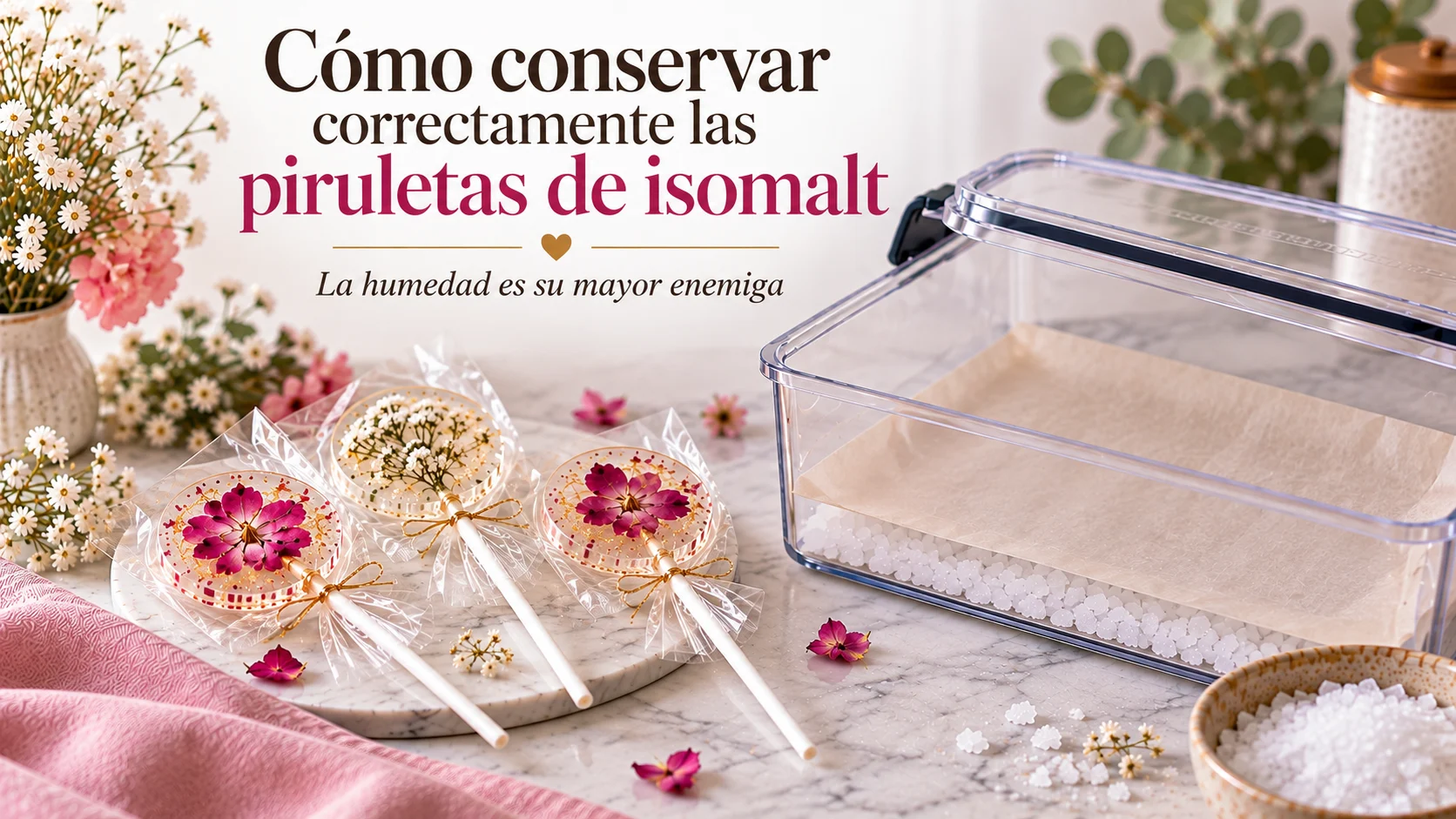
You’ve finished your isomalt lollipops, they’re transparent, shiny, perfect… and now comes a part that we often overlook: storing them properly.
Yes, working the isomalt properly is important, controlling its temperature is important too, and making a pretty lollipop is, of course. But if we then leave it exposed to humidity, all that work can be ruined.
And if there’s one thing I repeat time and time again when I teach how to work with isomalt, it’s this:
Humidity is isomalt’s biggest enemy.
It doesn’t matter how beautiful your lollipop is. If you don’t protect it properly after making it, it can start to lose its shine, become dull and sticky, and even end up spoiled.
So today I want to explain how to properly store your isomalt lollipops, why humidity affects them so much, and how you can easily prepare a humidity-proof box using one of my greatest allies when working with candy: calcium chloride.
Why does humidity affect isomalt so much?
Isomalt is a hygroscopic material. Put much more simply: it tends to absorb moisture from the environment.
And here’s where the problem begins.
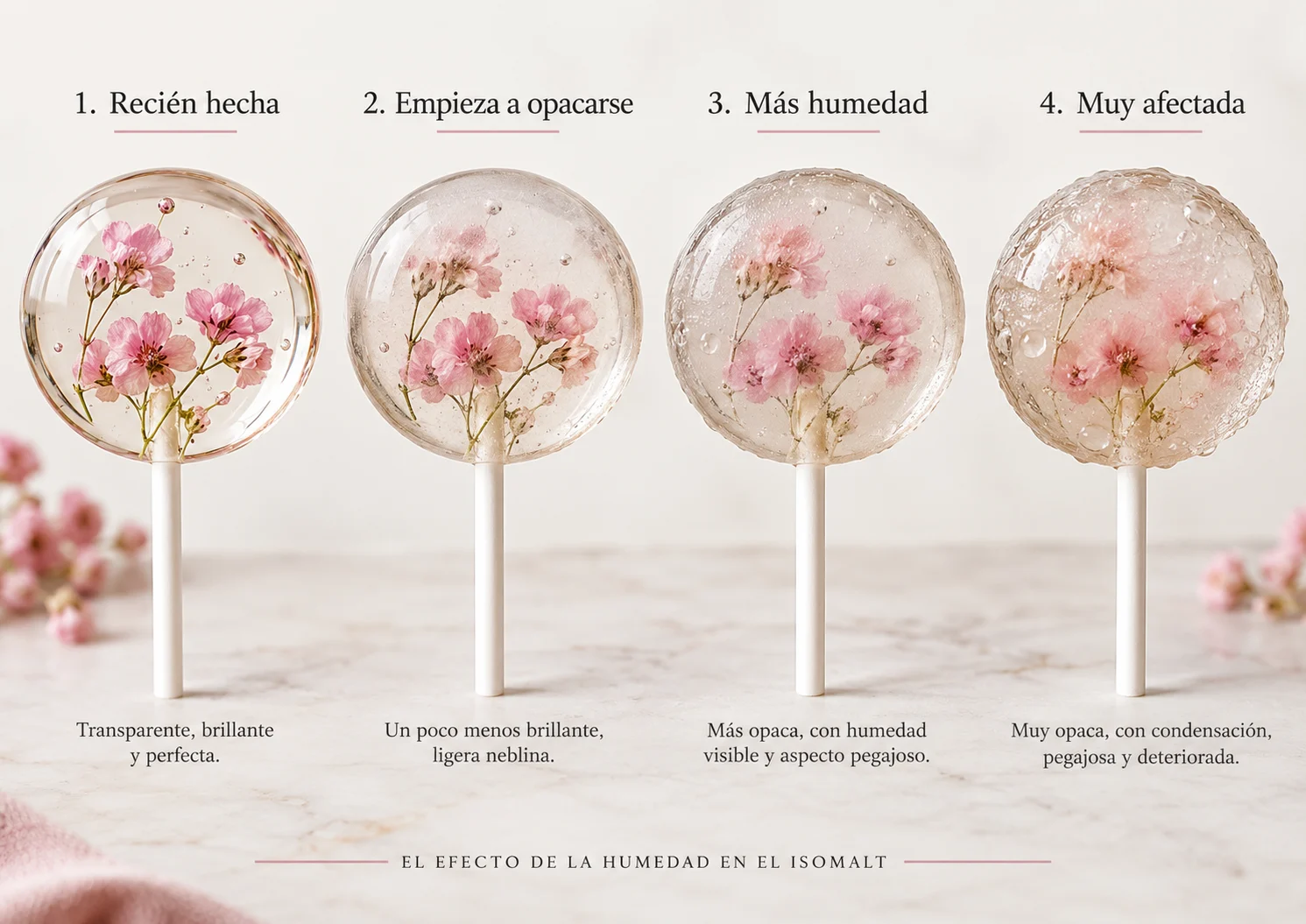
When we make a lollipop, we want it to retain the characteristic transparency and shine of isomalt. But if we leave it exposed to the air, especially in high humidity, that moisture will gradually affect its surface.
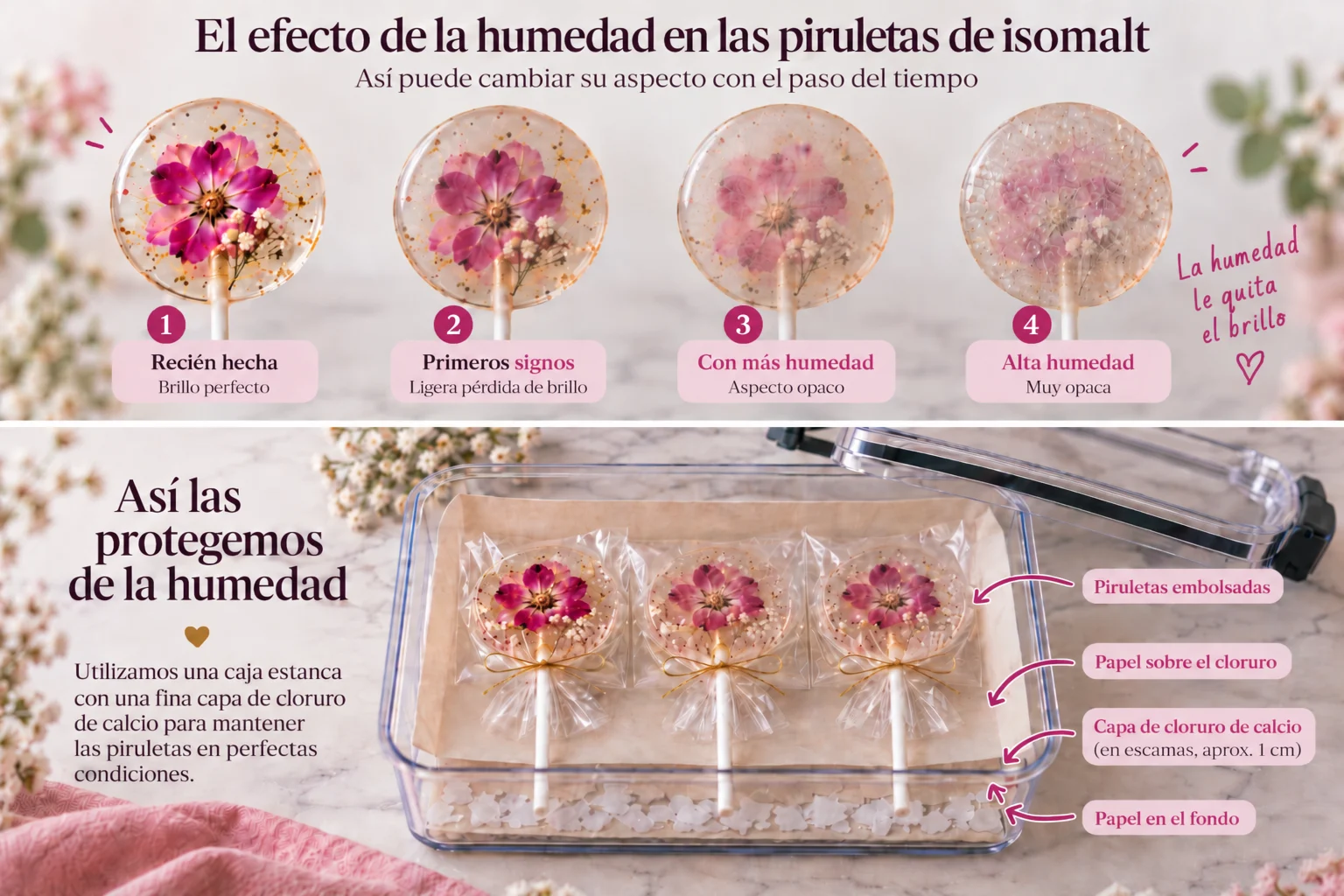
The first sign might simply be that the lollipop no longer looks as shiny. Then it might start to look slightly dull. And if exposure continues, we might end up with a sticky surface or a lollipop that no longer has that beautiful, crystalline finish it had when we first made it.
That’s why the preservation of isomalt begins practically at the same moment we finish working with it.
And here’s a very important point: we shouldn’t wait until the lollipop is completely cold before packaging it, especially if we’re working in a humid environment.
The ideal time is when it’s lukewarm. Neither hot nor cold.
If we bag it while it’s too hot, we can deform it and also create condensation inside the bag. But if we wait until it’s completely cool, especially when there’s a lot of humidity in the air, the isomalt will have already started to absorb that moisture and may begin to get sticky.
So that temperate point is key: the lollipop already has enough consistency not to deform, but it hasn’t been exposed to the environment for too long yet.
Where does that humidity come from?
When we talk about humidity, it doesn’t necessarily mean your lollipops are near water. Humidity is in the air itself. And depending on where you live, there can be a lot of it. I work in Alicante, so you can imagine how familiar I am with it.
But in addition to the climate in our area, there are other situations that can exacerbate the problem:
- Rainy days.
- Kitchens with lots of steam.
- Open windows when the outside humidity is high.
- Cook while we have the finished lollipops nearby.
- Store them in containers that do not close properly.
- Leaving them on a table for too long before packaging them.
- Constantly opening the box where we have them stored.
- Sudden changes in temperature.
So you don’t have to focus solely on whether it’s hot. Heat and humidity aren’t the same thing. You can have a day that isn’t particularly hot but has very high humidity, and on that day your lollipops will still need plenty of protection.
First rule: don’t leave finished lollipops out in the open
This is probably one of the easiest mistakes to avoid. You finish a beautiful batch, place it on the table, and move on to the next ones. An hour passes. Then another. And all the while, those first lollipops have been exposed to the air for that entire time.
If you’re working in a dry place you might not notice much of a difference, but when we work in humid areas, every minute of exposure counts.
My recommendation is simple: when the lollipop is lukewarm and holds its shape perfectly, package it. Don’t wait until it’s completely cool if it’s very humid, because by then it may have started absorbing moisture from the air. And don’t package it too soon either, while it’s still warm and soft. Finding that exact point is part of learning about isomalt.
Package each lollipop individually
For the lollipops we use food-grade polypropylene bags that help to isolate them from the outside environment.
But here’s one of the keys to the whole process: choosing the right time for packaging. The lollipop should be lukewarm.
If it’s still warm, two things we don’t want can happen: first, it can become misshapen inside the bag. Second, the residual heat can encourage condensation. But if we wait too long and let it cool completely, especially in humid environments, it will have already absorbed moisture from the air.
Therefore, the right point is that intermediate moment when:
- The lollipop is now firm.
- It does not deform when handled.
- It’s not hot anymore.
- But it still retains some temperature.
That’s the moment to put it in its bag and seal it properly. The less time it’s exposed to air, the better it will retain its transparency, shine, and texture.
The dehumidifying box: my must-have when working with isomalt
If you regularly work with isomalt, especially if you live in a humid area, I recommend preparing a dehumidifier box. It’s very easy to make and I find it practically essential.
What do you need?
- A watertight box (an insulated box or a plastic container that seals really well — the important thing is that it is watertight; a cardboard box won’t work, even if it’s thick, because cardboard is porous).
- Baking paper.
- Calcium chloride.
- Your lollipops already packaged and protected.
How to prepare a moisture-proof box with calcium chloride
Preparing it is very easy.
First, place a sheet of parchment paper covering the bottom of the box. On top of that paper, spread a thin layer of calcium chloride. You don’t need to fill half the box; a small layer spread across the base is enough. Then place another sheet of parchment paper on top. And on that second sheet, we will place our pieces.
I want to emphasize something important here: isomalt should never come into direct contact with calcium chloride. The chloride is not added to the isomalt. It is not sprinkled on the lollipops. It does not come into contact with them. Its function is to absorb any moisture that may be inside the box.
It might seem like an unnecessary explanation, but it’s a question I’ve been asked countless times: “Mayte, when do I add the chloride to the isomalt?” Never! The chloride is only kept inside our dehumidifying box, separate from the pieces.
Why do I use calcium chloride and not just silica gel?
Silica gel can be helpful in certain environments, but when working in humid areas, we need something more powerful. Calcium chloride has a high hygroscopic capacity, meaning it absorbs ambient moisture. That’s why I find it especially useful for creating these preservation boxes.
In humid areas, the difference can be enormous. If you’ve ever finished a beautiful piece and then found that it had lost its transparency, you’ll know exactly what I’m talking about.
How do I know when I need to change the chloride?
Calcium chloride absorbs moisture gradually. Over time, you’ll notice changes in its appearance, usually starting at the edges and corners. The flakes will begin to clump together or harden and may start to ooze liquid as they absorb moisture. Remove any damp or hardened areas you see. As long as the rest of the calcium chloride remains dry, it can still do its job.
And remember another important thing: every time you open the box, fresh air enters, bringing with it moisture. That’s why it’s not a good idea to constantly open and close a preservation box. If you’re doing a large production run, organize your work so you only open it when necessary.
Where should we store the box with the lollipops?
Once properly protected, find a dry, cool place away from direct sunlight.
And here’s another very common mistake: thinking that, since we want to preserve them, the best thing to do is put them in the refrigerator. No. The problem isn’t just the refrigerator temperature, but what can happen when we take the cold lollipop out into a warmer environment: condensation can form. And we already know which ingredient we don’t want near our lollipops: water.
So, to preserve isomalt, we don’t look for cold. We primarily look for the absence of moisture.
Heat is also bad for lollipops, especially if it’s excessive or if they’re in direct sunlight. That’s why we should never leave them: inside a car in the sun, next to a window with direct sunlight, near an oven, next to a heat source, or outdoors for hours in the middle of summer.
The ideal situation is a cool, dry, and stable place. But of all the factors, I insist: humidity is the one we must monitor most closely.
How long can isomalt lollipops be stored?
If properly made, packaged, and protected from moisture, isomalt lollipops can be stored for a long time. However, environmental conditions must always be taken into account: storing a lollipop in a dry climate is not the same as storing it in a coastal city with high humidity.
That’s why, when we talk about preserving isomalt, I prefer not to focus solely on a date. What’s really important is how you’re preserving it.
If it’s an order for a wedding, communion, birthday, or other event, you don’t need to keep the lollipops stored for months on end. My recommendation is to avoid placing orders unnecessarily far in advance and always keep them in their packaging and properly protected until you’re ready to use them.
My lollipop has become a little dull, is it spoiled?
Not necessarily. If moisture has begun to slightly affect the surface, you may notice that it loses transparency and appears somewhat matte or opaque.
In some cases, we can restore the surface shine using a kitchen torch, being very careful. First, remove the lollipop from its bag and give it a very quick, controlled pass with the torch. We don’t want to melt it again; we simply want to work on that thin surface layer. Then, let it cool down, and when it’s warm and firm again, put it back in a clean bag and seal it.
Again, there’s no need to wait until it’s completely cold. But this is just a temporary solution. The real solution remains preventing moisture from affecting it in the first place.
Mistakes that can ruin the preservation of your lollipops
After many years working with isomalt, these are some of the mistakes I see repeated most frequently:
- Leaving the finished lollipops exposed to the air for too long. Even if they look perfect when you finish making them, they continue to absorb ambient moisture.
- Wait until they are completely cool before bagging them in a humid environment. By then, the surface may have already begun to absorb moisture and become sticky.
- Bag them while they are still hot. They can become misshapen and also generate condensation inside the bag.
- Use a box that isn’t airtight. If air is constantly getting in, moisture will get in too.
- Use cardboard as a moisture-proof box. It is a porous material.
- Never put calcium chloride in contact with lollipops.
- Store the lollipops in the refrigerator. Temperature changes can cause condensation.
- Leaving them exposed to the sun. Direct heat doesn’t help preserve them either.
- Opening the dehumidifier box constantly. Each opening introduces humid air.
What happens to the lollipops once they are bagged?
The individual bag is our first line of defense. The moisture-proof box adds a second layer, which is especially important when the lollipops need to be stored before being given out or used. In other words, I don’t see one as a substitute for the other.
Think in terms of layers of protection: Warm, firm lollipop → properly sealed bag → well-protected box → dry, sun-free environment. The better you control this entire process, the fewer problems you’ll have.
Preservation begins long before storing the lollipop
And this point seems especially important to me. We often think about “preserving” only once the lollipop is made. But working correctly with isomalt means controlling the entire process: the temperature, the cooling, the handling, the exact moment of packaging, and finally, the storage.
When you begin to understand how isomalt behaves, you also learn to anticipate problems. And one of those things you learn with practice is precisely to recognize that point at which the lollipop is lukewarm, firm enough to be bagged, and hasn’t yet begun to suffer too much from the ambient humidity. It’s not a matter of waiting an exact number of minutes: you have to observe the piece and understand how the isomalt responds. And that’s one of the big differences between making a lollipop now and then and truly learning to work with isomalt.
Frequently asked questions about the preservation of isomalt lollipops
What is the biggest enemy of isomalt lollipops?
Humidity. Isomalt tends to absorb moisture from the environment, which can cause it to lose its shine, become dull, or end up sticky.
When should I bag an isomalt lollipop?
The best time is when it’s lukewarm and holds its shape perfectly. It shouldn’t be hot, as this could cause it to deform and create condensation inside the bag. But it’s also not a good idea to wait until it’s completely cold, especially in humid environments, because by then it may have already started to absorb moisture.
Do I need to add calcium chloride to the isomalt?
No. Never. Calcium chloride is used inside a moisture-proof box and must always be kept separate from lollipops.
Can I use silica gel?
It can help in low-humidity environments. In climates with high humidity, I prefer to use calcium chloride because of its ability to absorb moisture.
Can I store lollipops in a cardboard box?
Cardboard isn’t the best material for creating a moisture-proof box because it’s porous. It’s preferable to use a sealed plastic container or an insulated box that closes properly.
Can I put the lollipops in the fridge?
It’s not recommended. Taking a cold item into a warmer environment can cause condensation to form on its surface.
What do I do if the lollipop loses a little shine?
If it’s just a slight surface dullness, a very controlled pass with a blowtorch can help restore the finish. Then let it cool down and re-bag it once it’s lukewarm and firm.
In short: protect them from moisture
If you want to take away just one idea from this entire article, let it be this:
Proper preservation of isomalt lollipops consists, above all, of keeping them away from moisture.
- Don’t wait for them to cool completely if you’re working in a humid environment.
- Find the point where they are warm and firm.
- Bag them properly.
- Store them in an airtight container.
- Use a dehumidifier box if necessary.
- Avoid the refrigerator, the sun, and sudden temperature changes.
And if you live in a humid area, befriend calcium chloride because it can save you from more than one headache.
When we learn to work with isomalt, we don’t just need to know how to cook or shape it. We also need to know when to touch it, when to handle it, and when to protect it from the environment. That exact moment of packaging is much more important than it seems. And believe me: after all the work that goes into making them, it’s worth taking care of them until the very end.
Do you want to learn more about isomalt?
On the blog you will find many more tips, techniques and solutions to the most common problems when working with isomalt.
And if you want to learn the whole process in a much more complete way, from cooking and temperature control to making and preserving your lollipops, you can check out my online courses.
Because the better you know isomalt, the easier it is to work with… and the more you can enjoy creating.



Leave A Comment