


Crispy on the outside, tender on the inside, with chunks of chocolate and that toasted hazelnut flavor that pairs dangerously well with cocoa. And yes: this time we’re putting the isomalt back in the oven.
After using it in desserts, creams and doughs like brownies, today we’re going to see what happens when we replace added sugar in one of those recipes that practically everyone recognizes: some good chocolate and hazelnut cookies with isomalt.
But here’s something interesting. In a cookie, sugar isn’t just for sweetness. It also influences how much the dough spreads during baking, its browning, its crispness, and its final texture. That’s why we’re not just going to leave out the sugar and cross our fingers.
We’re going to formulate the recipe specifically with isomalt to achieve cookies with a rich chocolate flavor, slightly crispy edges, and a softer interior. Shall we begin?
- 🍪 Quantity: 12 large cookies
- ⏱️ Preparation time: 20 minutes
- ❄️ Dough resting time: 45 minutes
- 🔥 Baking time: 10–12 minutes per batch
- ⏳ Approximate total time: 1 hour and 20 minutes
- 🌡️ Temperature: 180 ºC, top and bottom heat
- ⭐ Difficulty: easy
- 🫙 Storage: 3–4 days in an airtight container
- 🚫 Added sugars: no, provided that the chocolate used does not contain them either
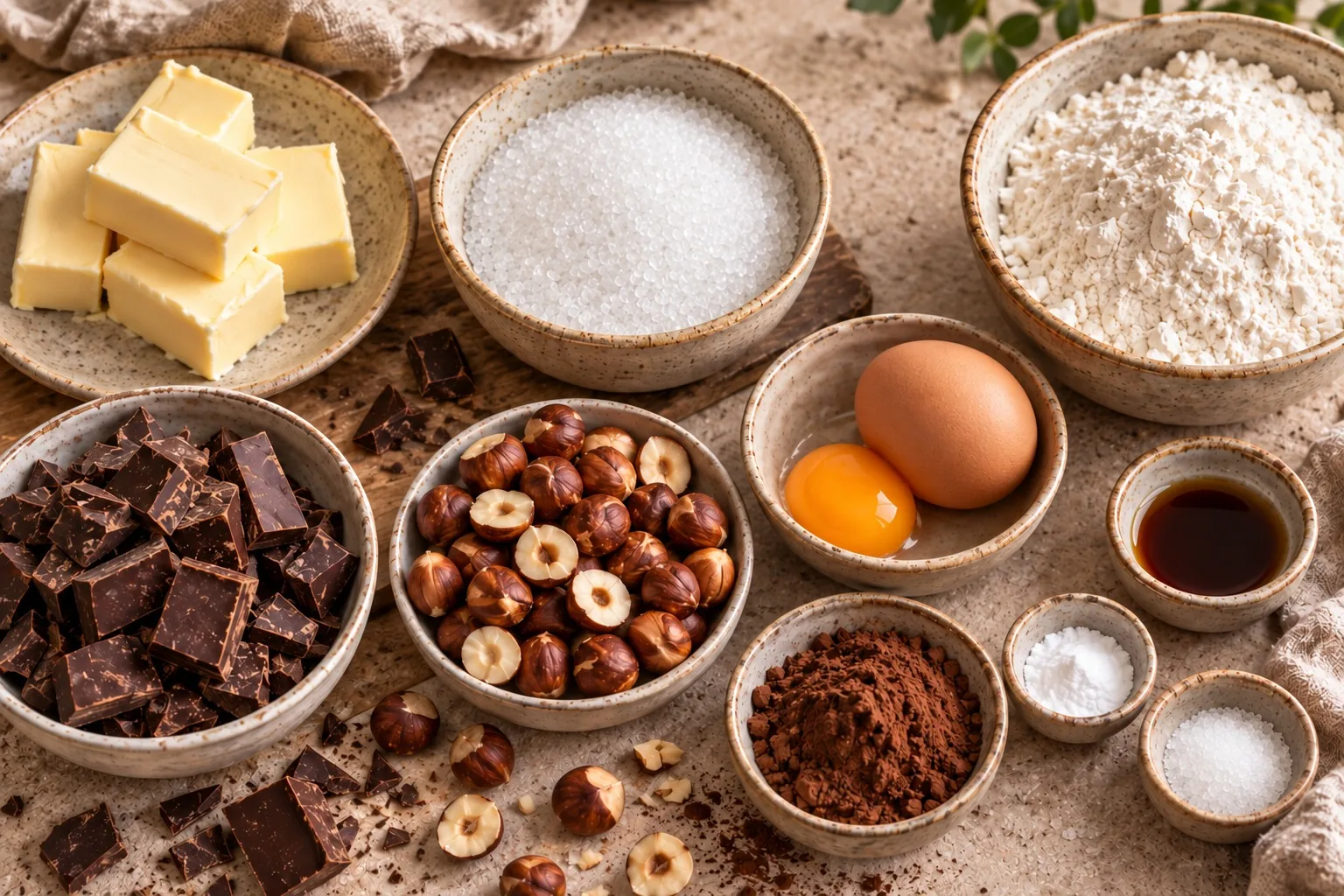
Ingredients
All the isomalt ingredients for this recipe can be found in our ingredients section.
- 110g of butter at room temperature
- 120 g of isomalt
- 1 egg
- 1 egg yolk
- 1 teaspoon of vanilla extract (or a few drops of vanilla-flavored food coloring)
- 170 g of wheat flour
- 25g of pure unsweetened cocoa
- 3 g of sodium bicarbonate
- 1 pinch of salt
- 100g of dark chocolate with no added sugar
- 90g of roasted hazelnuts
For those with a sweet tooth
As we know, isomalt is less sweet than sugar. These cookies are designed to showcase the intense flavor of cocoa and chocolate. If you prefer significantly sweeter cookies, you can supplement the isomalt with a small amount of a strong baking sweetener, always respecting the manufacturer’s recommended amounts. I don’t recommend drastically increasing the amount of isomalt simply to achieve greater sweetness, as this would also alter the dough’s structure.
How to make chocolate and hazelnut cookies with isomalt step by step
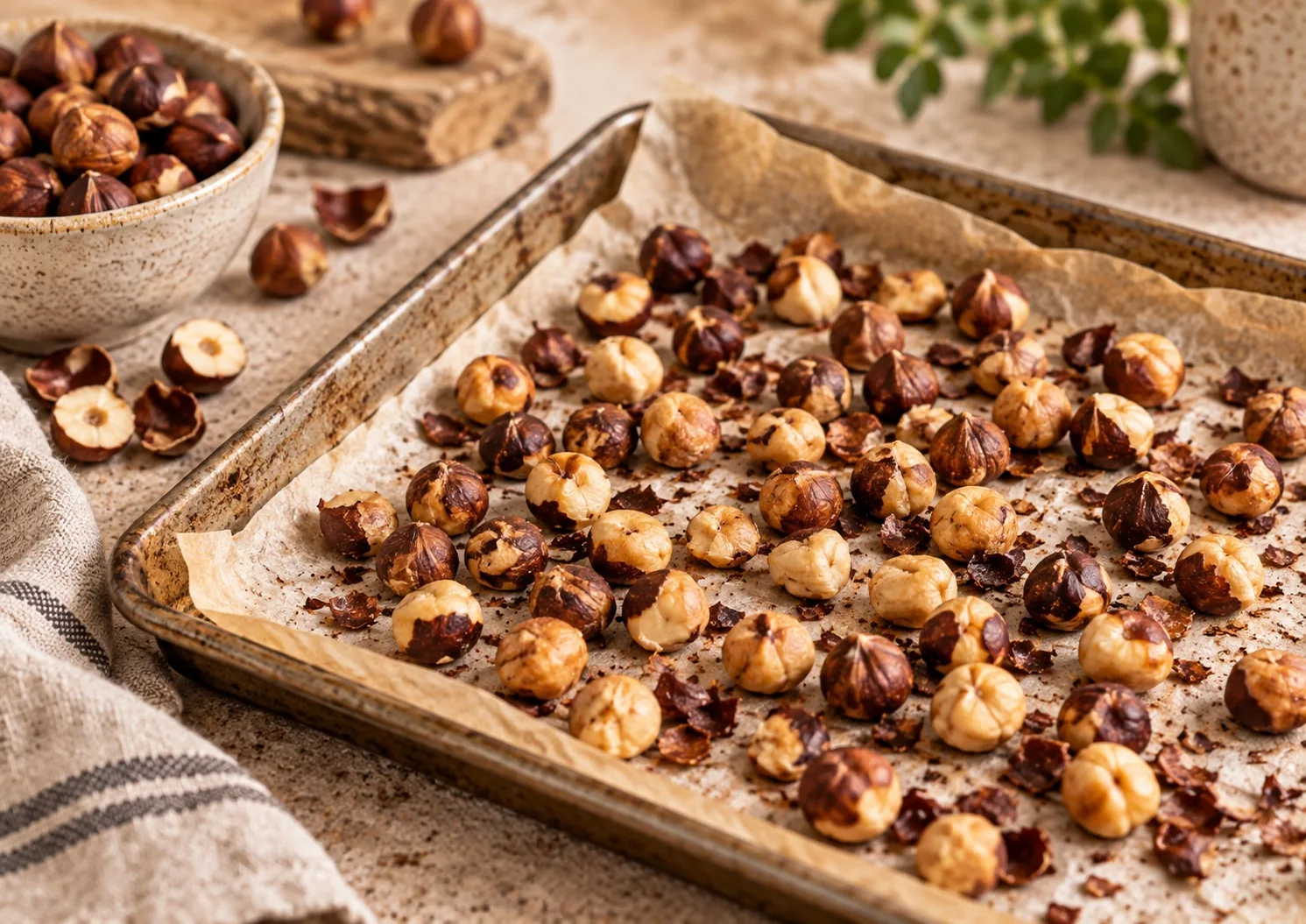
1. We toast the hazelnuts
If your hazelnuts are already roasted, you can skip this step. If they are raw, spread them on a baking sheet and bake them for approximately 8–10 minutes at 160°C (325°F). Let them cool and lightly rub them with a clean cloth to remove some of the skin. They don’t need to be completely peeled.
Roughly chop the hazelnuts. And here’s a tip: don’t chop them too finely. We want to find pieces of hazelnut when we bite into the cookie, not turn them into powder.
2. We prepare the chocolate
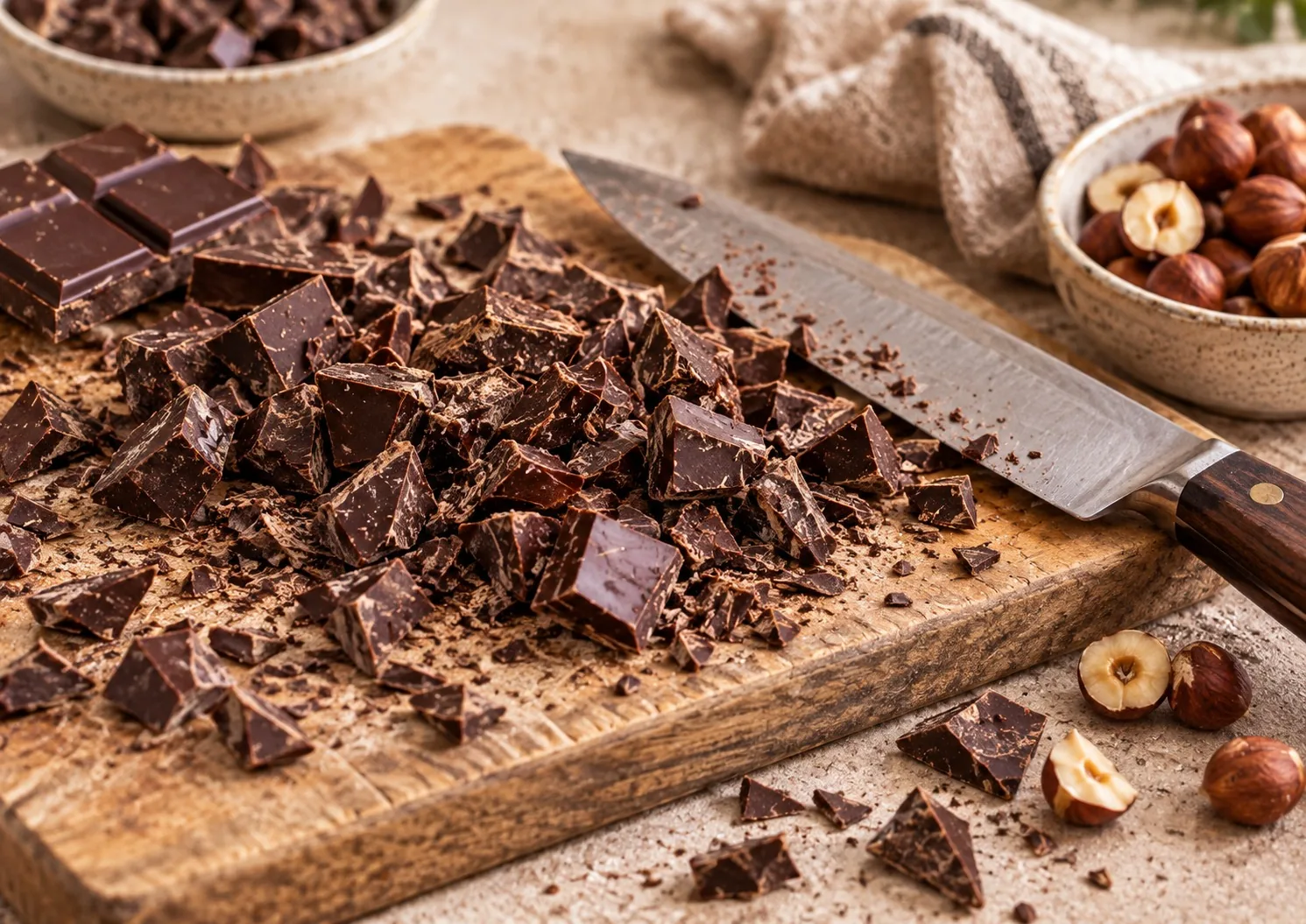
Chop the 100g of unsweetened dark chocolate. Make pieces of varying sizes: the smaller ones will blend into the dough, and the larger ones will create those molten chocolate zones that appear when you break the cookie. And we all know that’s one of the best parts. Set aside.
3. Beat the butter with the isomalt
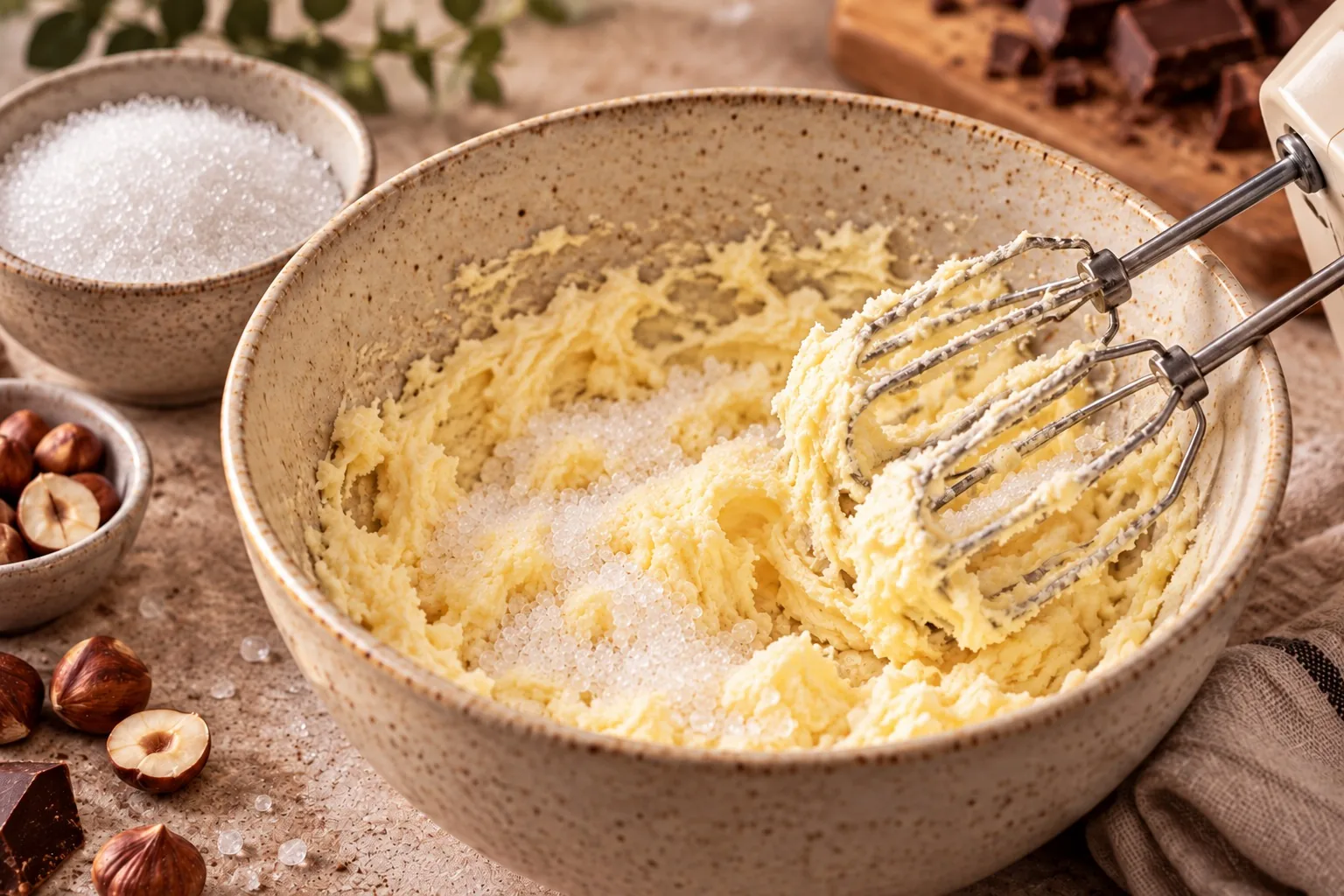
Put the room temperature butter in a bowl and add the 120g of isomalt. Beat for approximately 2–3 minutes.
Don’t expect to get exactly the same airy cream you’d get using regular sugar. Isomalt behaves differently: we simply want it to be well distributed throughout the butter.
Does your isomalt have a very coarse grain? You can lightly crush it for a few seconds before using it. There’s no need to turn it into a powder; we’re simply aiming to reduce the crystal size slightly so it blends better into the dough.
4. Add the egg and the yolk
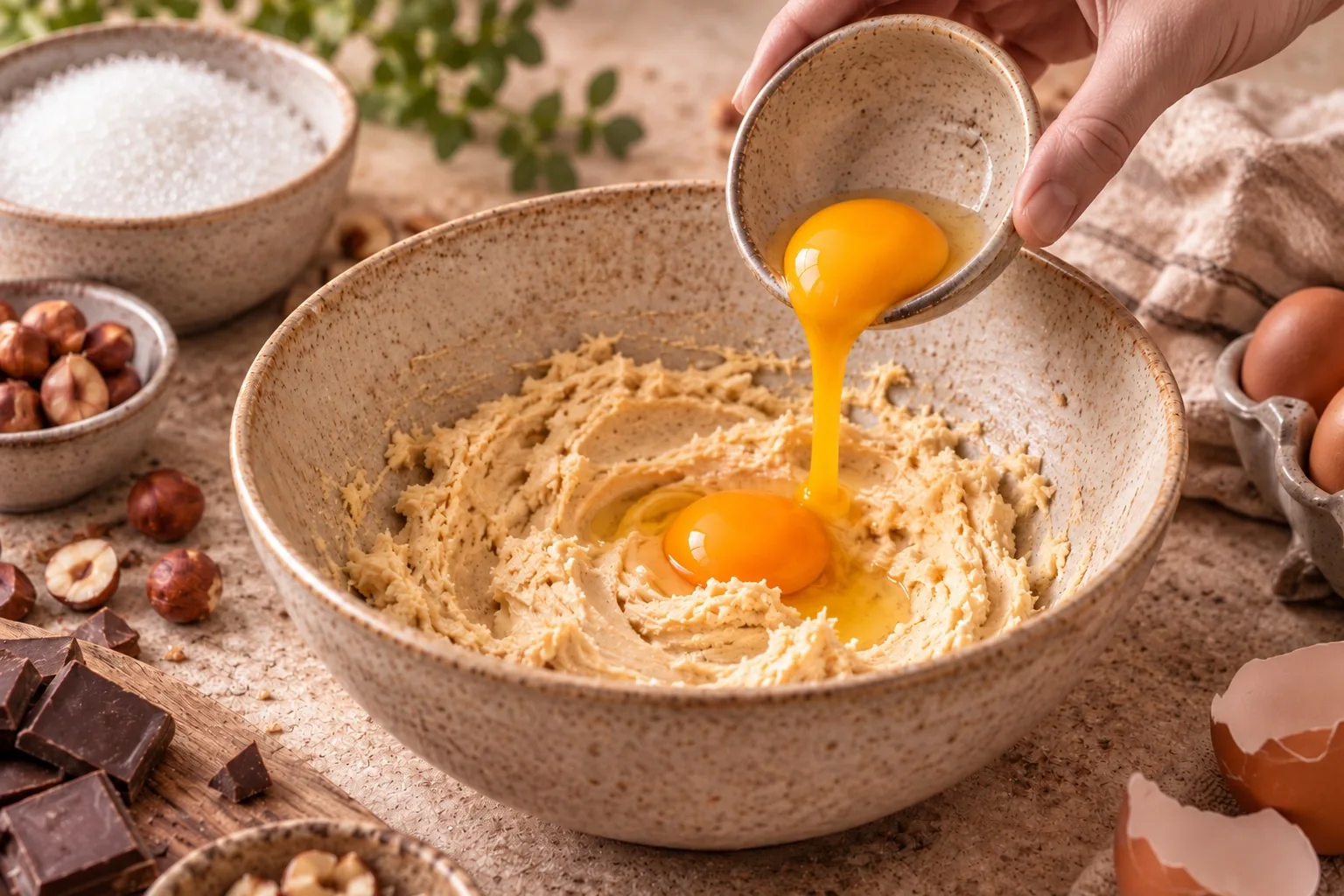
Add the egg and mix. Then add the yolk and mix again until you have a smooth mixture. Add the vanilla as well.
Why do we use an extra egg yolk? Because it adds fat and creaminess, something that is especially important to us in order to achieve a tender cookie and avoid an excessively dry texture.
5. Mix the dry ingredients
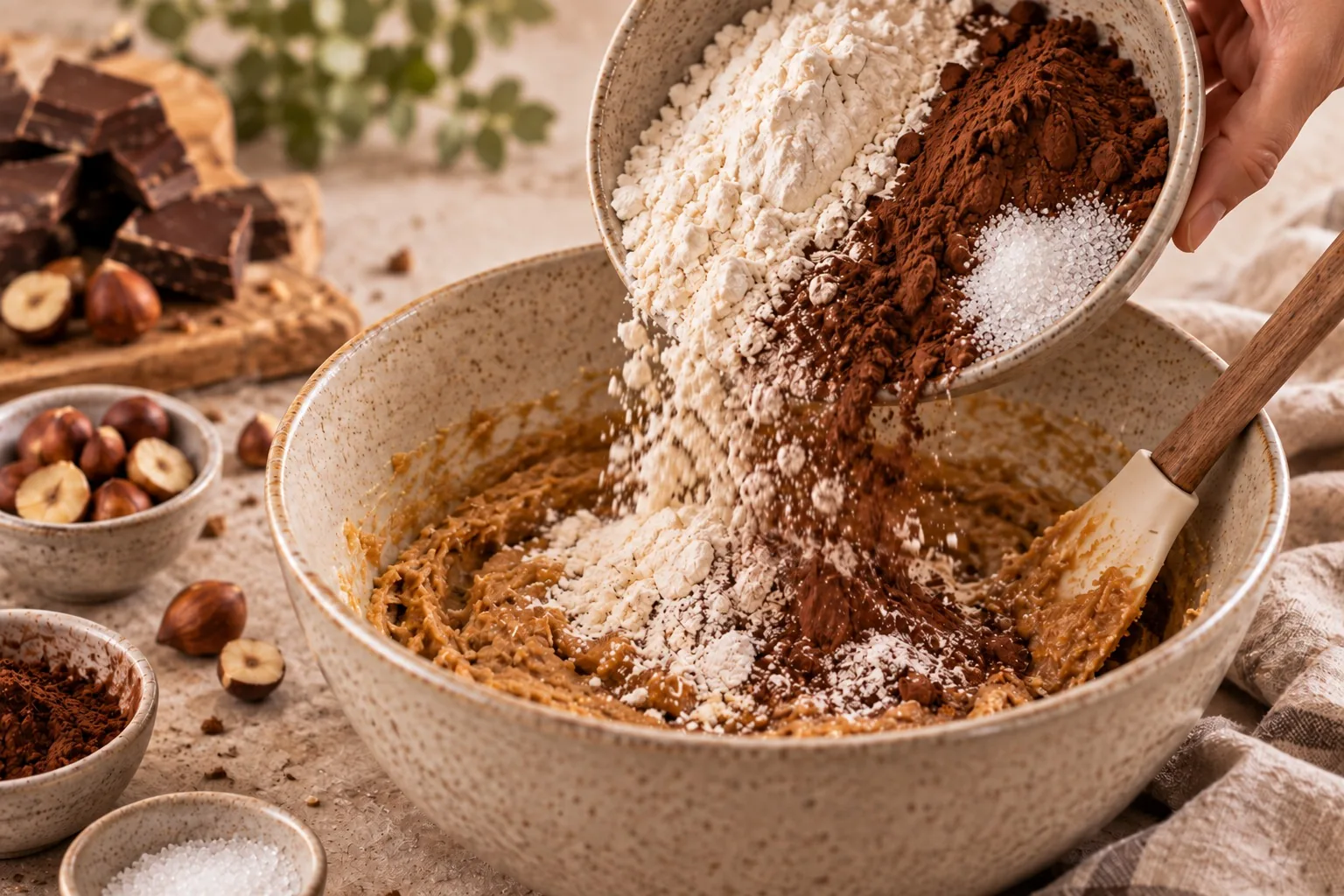
In another bowl, mix the flour, cocoa powder, baking soda, and salt. Gradually add the dry ingredients to the wet ingredients and mix only until all visible traces of flour are gone.
Don’t overmix. Once we add the flour, we don’t want to work the dough for too long. We want cookies, not a kneading competition.
6. Chocolate, hazelnuts and resting
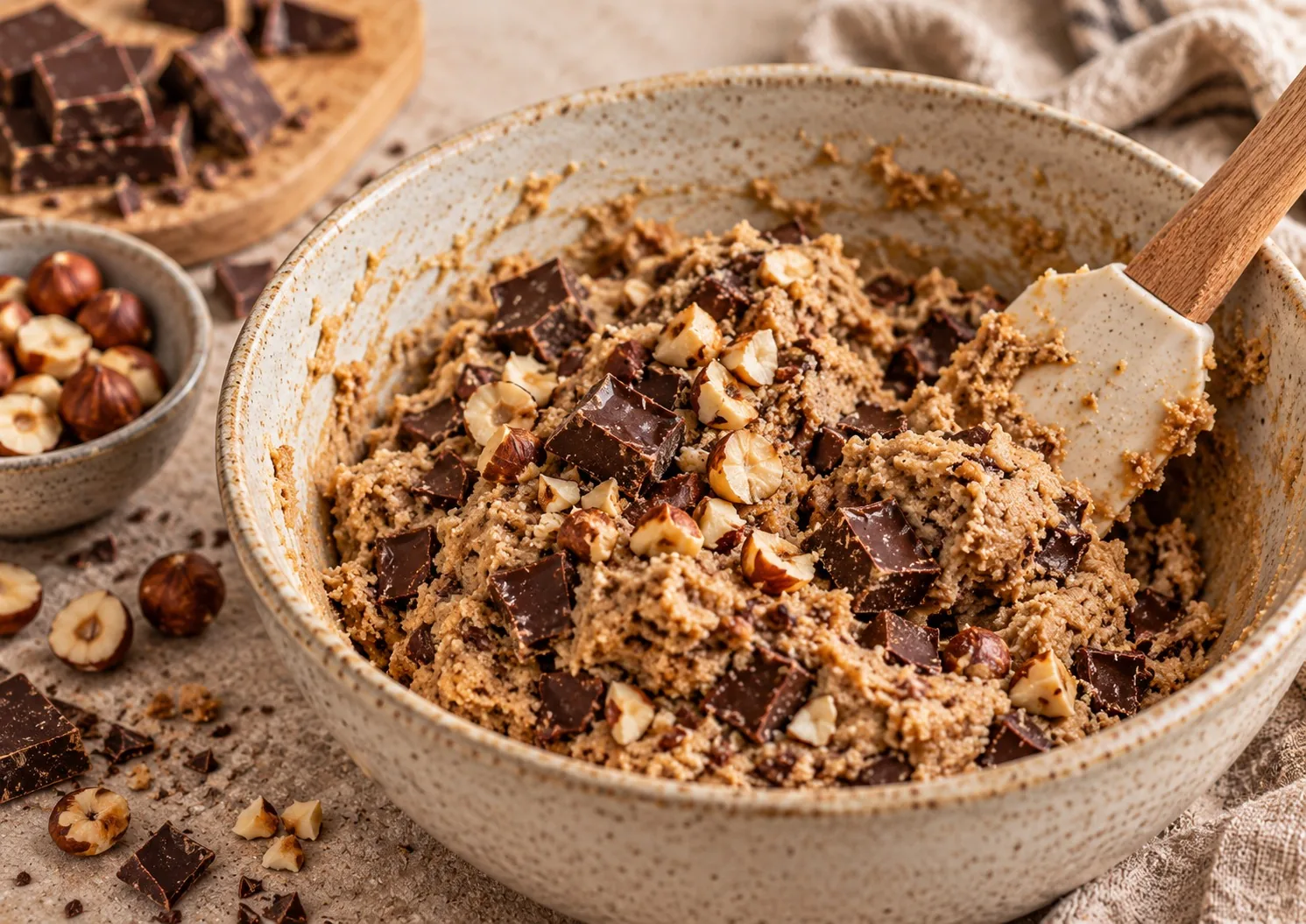
Add approximately 80g of the chopped chocolate and 70g of the hazelnuts. Set aside the rest to sprinkle on top of the cookies before baking. Mix everything together with a spatula: the dough will be quite compact, and that’s exactly what we want.
Resting: Don’t skip it. Cover the bowl and refrigerate the dough for about 45 minutes. This step helps the flour hydrate better, chills the butter, controls how much the cookie spreads, and results in a nicer shape during baking. If you’re in a hurry, you could reduce the time slightly, but for best results, give it the full 45 minutes. The cookie will thank you.
7. We create cookies
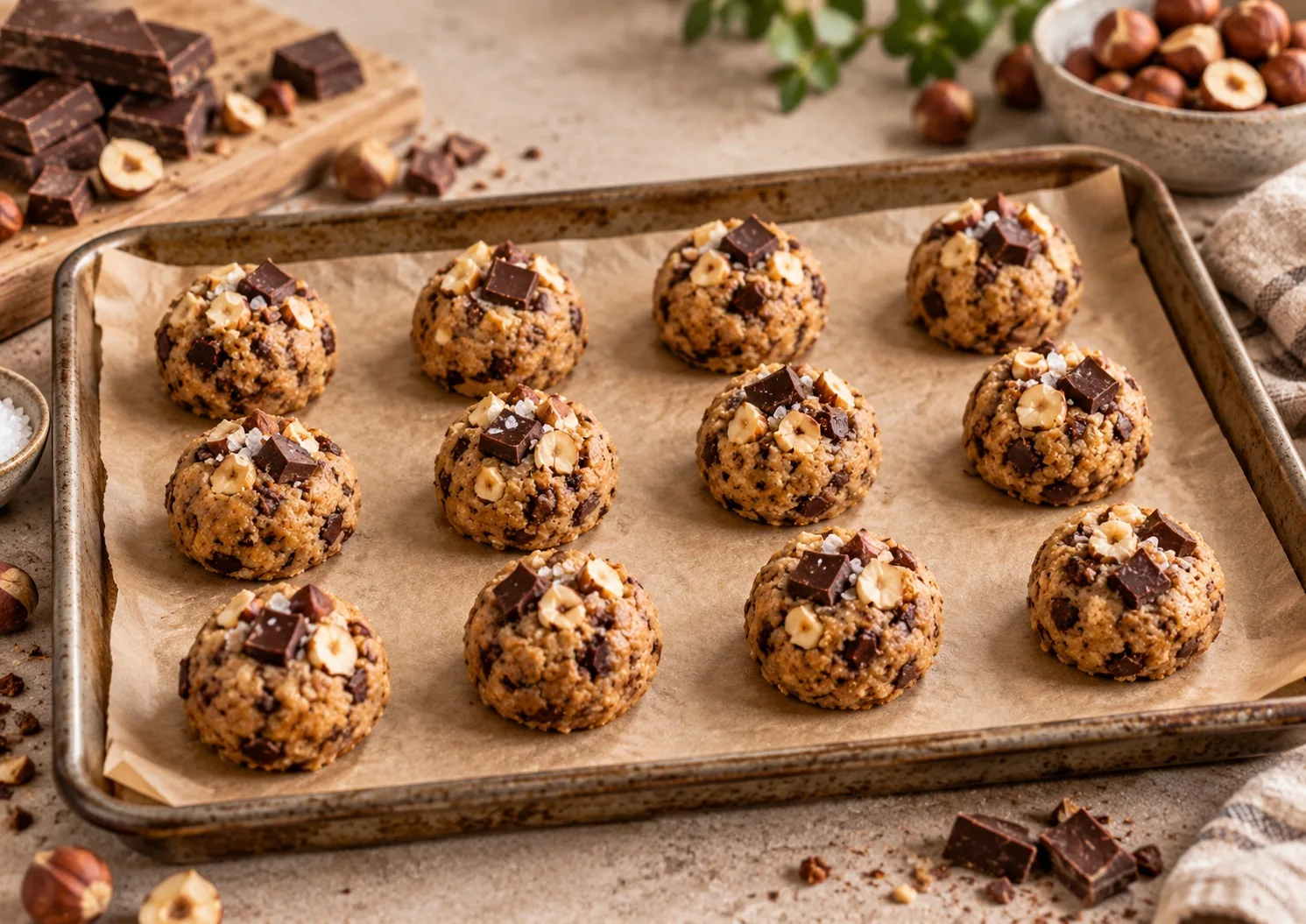
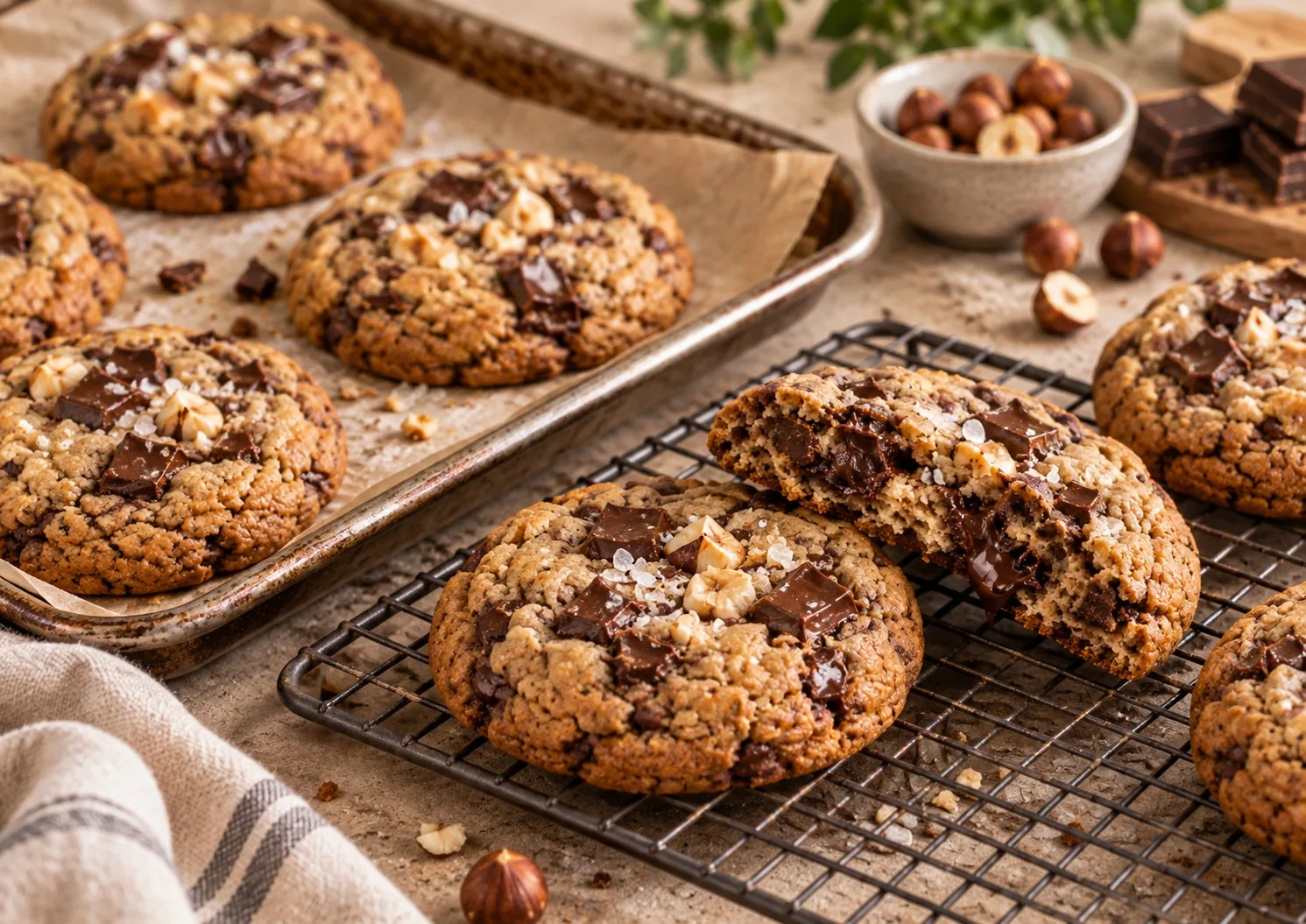
Preheat the oven to 180°C (350°F), conventional setting (top and bottom heat), and line a baking tray with parchment paper or a silicone baking mat (suitable up to 230°C/450°F and completely non-stick). Divide the dough into approximately 12 portions of 55–60 g each. Shape into balls without pressing too tightly and place them well apart from each other.
Lightly press down on the surface and place some pieces of chocolate and hazelnut on top. Besides adding flavor, this will make them look much more appealing.
8. We bake them and leave them alone
Bake for approximately 10–12 minutes. This point is especially important when working with isomalt: don’t wait until the cookies are very golden brown. Isomalt doesn’t develop the same color as regular sugar, so if you wait until they’re very toasted, you’ll probably overbake them. Instead, observe the texture: the edges should be firm, and the center may still feel slightly soft.
When you take the tray out, the cookies may still seem too soft. Don’t touch them. Let them rest on the tray for about 10 minutes; they’ll firm up as they cool. Then carefully transfer them to a wire rack.
And now you can start calculating how long it will take for the first one to disappear.
What should these cookies look like?
We’re aiming for a combination of textures: slightly crispy at the edges, soft in the center, with crunchy pieces of hazelnut and chocolate. We’re not trying to exactly replicate a cookie made with a lot of sugar. We’re creating a different formulation where isomalt replaces added sugar, and therefore some aspects of the final product change. And that’s precisely what’s so interesting about experimenting with this ingredient.
What is the function of isomalt in cookies?
Here’s the fun part for those of us who want to know what’s really going on inside the oven. When we make a traditional cookie, sugar affects the sweetness, the spread of the dough, the texture, the moisture, the browning, and the crispness. By replacing it with isomalt, we can’t expect exactly the same results.
Isomalt adds volume and sweetness, but it has a lower sweetening power and behaves differently during baking. That’s why we’ve adjusted other elements of the recipe, such as the amount of butter and the addition of an extra egg yolk. The goal isn’t to create an exact copy of a traditional cookie; the goal is to create a good cookie specifically formulated with isomalt.
Why might these cookies turn out less golden brown?
Because the color of a cookie doesn’t depend solely on baking time: the type of sweetener used also plays a role. With isomalt, it’s normal to get a different golden color than with a recipe made with sugar. That’s why I want to emphasize again: don’t rely solely on color to decide when they’re done. Observe the edges and the texture of the center.
Chocolate without added sugars: always check the label
Here we can make a small mistake without realizing it. We’re preparing a recipe without added sugars, but some chocolates contain them. Choose a dark chocolate without added sugars and check the ingredients. You’ll also find chocolates sweetened with different types of polyols or sweeteners, which can slightly alter both the flavor and the final nutritional information of the cookies.
Versions for chocolate lovers
An even more chocolatey version
If you’re one of those people for whom 100g of chocolate is never enough—I totally get it—you can increase the amount of chocolate chunks by using 120–130g of unsweetened dark chocolate. You can also reserve some larger pieces to place on top of the cookies before baking. They look spectacular.
Chocolate, hazelnut and coffee cookies
Another combination that works particularly well is adding ½–1 teaspoon of instant coffee. We’re not trying to make a coffee cookie: in small quantities, the coffee helps enhance the perception of cocoa and makes the chocolate even more intense.
Can I substitute almond flour for the flour?
Not necessarily in the same quantity. Almond flour contains much more fat and doesn’t develop the same structure as wheat flour. If we want to make a wheat-flour-free version, it would be best to create a specific recipe, rather than simply substituting ingredients one by one.
Possible substitutions
- Hazelnuts → walnuts: more classic flavor.
- Hazelnuts → roasted almonds: milder flavor.
- Dark chocolate → milk chocolate without added sugars: sweeter and softer cookie.
- Vanilla → instant coffee: intensifies the chocolate.
- Wheat flour → spelt flour: may slightly change absorption and texture.
- Butter → lactose-free butter: very similar result.
- Pure cocoa → defatted cocoa: may be slightly drier.
Approximate nutritional information
The following values are calculated for a recipe divided into 12 cookies and using butter, wheat flour, pure cocoa, 120g of isomalt, unsweetened dark chocolate, and 90g of hazelnuts. These are guidelines only: the composition may vary considerably depending, especially, on the type of chocolate used.
Per cookie, approximately:
- Energy value: 242 kcal / 1,013 kJ
- Fats: 16.5 g
- of which saturated: 7.5 g
- Carbohydrates: 26.3 g
- of which sugars: 0.6 g
- Polyols from isomalt: approx. 10g
- Fiber: 2.7 g
- Protein: 4.4 g
Polyol levels may be higher if the sugar-free chocolate used also contains polyols.
Important: no added sugar does not mean no calories. We have butter, chocolate, and hazelnuts, all ingredients with a considerable energy content. The goal here is not to create a “light” cookie, but to explore how to make a cookie without adding conventional sugar using isomalt.
Conservation
Once completely cooled, store them in an airtight container. They will keep for approximately 3–4 days. To best preserve their texture, avoid leaving them exposed to air for too long.
Can I freeze the dough?
Yes, and it’s a fantastic option. Shape the dough into balls before freezing and place them separately on a baking sheet. Once frozen, you can store them together in a bag or suitable container. This way, you can bake only the cookies you need. Because having cookie dough waiting in the freezer never seems like a bad idea.
Can I freeze baked cookies?
Also. Let them cool completely and freeze them in an airtight container. To eat them, let them thaw at room temperature. You can warm them briefly afterward to soften the chocolate slightly.
Frequently Asked Questions
Do cookies with isomalt taste the same as cookies with sugar? Not exactly. Isomalt is less sweet, and its behavior during baking is also different. These cookies are formulated to have a fairly intense chocolate flavor and a moderate sweetness.
Can I substitute 120g of isomalt with 120g of another sweetener? Not necessarily. Each sweetener has a different sweetening power and technological properties. Intense sweeteners, in particular, are used in very small quantities and do not provide the same volume as isomalt.
Why didn’t my cookies spread as much as traditional ones? It can happen. Isomalt doesn’t behave exactly like sugar during baking. The dough temperature, the amount of butter, the size of the cookies, and the resting time also play a role. If you want slightly wider cookies, flatten each ball of dough a little before putting them in the oven.
Why are they soft when they come out of the oven? Because they’re still very hot. The cookies will continue to firm up as they cool. Leave them on the baking sheet for about 10 minutes before moving them.
How do I know they’re done if they’re not golden brown? Look at the edges. They should be firm and the center slightly soft, but not runny. Don’t wait for a very dark brown color, or you might over-dry them.
Can I leave out the hazelnuts? Of course. You can simply make them with chocolate or substitute the hazelnuts with another nut. That said, the chocolate and hazelnut combination has more than enough reasons to have become a classic.
Can I make them smaller? Yes. If you make cookies that are about 30–35g, you’ll need to reduce the baking time. Start checking them after about 7–8 minutes.
Can I use granulated isomalt? Yes. The bagged isomalt we use in this recipe is granulated. If the granules are very coarse, you can lightly crush them before mixing them with the butter for a more even distribution. It doesn’t need to be completely ground into a powder.
Can eating a lot of isomalt cause digestive discomfort? As with other polyols, consuming high amounts can cause digestive discomfort in some people. These cookies contain approximately 10g of isomalt per cookie if we make 12 cookies, so moderation is also part of the recipe.
We continue to discover what we can do with isomalt
And this is precisely what I love most about this recipe series. We started by seeing isomalt as the perfect ingredient for making clear candies and spectacular lollipops, but little by little we’re taking it to other areas. Brownies, cheesecakes, spoon desserts … and now chocolate and hazelnut cookies. And let’s not forget the lollipops: we’ve already told you which paper to choose—rice paper, wafer paper, or sugar paper — how to properly store isomalt lollipops, and whether isomalt contains gluten.
Each recipe teaches us something different about its behavior. Because replacing sugar isn’t simply about swapping one ingredient for another: you have to understand what the sugar did in the recipe and how you can achieve a good texture using isomalt. The bagged isomalt we use in this recipe is the same we use in all our sugar-free sweets, and in our kitchenware section you’ll find accessories to prepare your own version at home.
And if you’d like to discover the other side of isomalt, the more artistic side, our online Masterclass in Isomalt Lollipops offers 6 video courses with lifetime access, and in the Learn to Bake Isomalt course, I’ll teach you how to cook it at the right temperature and time to achieve stable and shiny pieces. You can also view all our online courses.
And after all that explanation, the truly important question remains: would you eat the freshly baked cookie with the chocolate still melted… or would you wait for it to cool down? I have a pretty clear answer.
If you make the recipe, let me know what you think and share it with that chocolate and hazelnut lover you know wouldn’t be able to resist. And keep an eye on the blog because we still have many more isomalt recipes to try.






Leave A Comment